
Forensic Case File Series: Guilty By Association™
Offense: Process Friction.
The documented process says one thing.
The operating process does another.
Employees know which approval to skip.
Which spreadsheet to use.
Which person can “make it happen.”
Which meeting can be avoided.
Which rule is real.
Which rule is decorative.
That is the evidence.
You are assigned to this case because the workaround culture is not happening around your organization. It is happening inside the system you permit, reward, and protect.
Guilty By Association™ means proximity creates responsibility.
If leaders know the official process is not being used and call the workaround “how we get things done,” the organization is already participating in the offense.
What We Learned
The Field Investigation for this case file does not include a defined community-response dataset, sample size, collection method, or calculation period.
No forensic percentages are presented.
This case is based on observable operating evidence: the gap between the process written down and the process people actually follow.
Case File Focus: Process Friction
The central question:
When the official path is slower than the informal path, which system is the organization truly running?
The answer is rarely the policy manual.
The answer is the workaround.
That does not make the workaround a shortcut.
It makes it a signal.
A workaround tells you where the architecture failed to support real work. It exposes unnecessary approvals, unclear ownership, missing information, broken handoffs, weak communication, or a decision path that cannot survive pressure.
The official system becomes decoration.
The unofficial system becomes culture.
That is how Stability Drift™ begins.
The Charge: Guilty By Association™
Ecosystem Step 1: The Charge.
The offense is not that employees found a faster way.
The offense is that leadership allowed the faster way to become invisible.
If the workaround is necessary to complete the work, then the formal process is not operational.
If the workaround depends on one experienced person, then the organization has a Human Glue Dependency™.
If the workaround is known but undocumented, then truth flow is restricted.
If the workaround produces repeated rework, escalation, or confusion, then performance is leaking.
Technical skill may help someone navigate a broken process.
Emotional intelligence may help them absorb the frustration.
Neither repairs the system.
Stability requires structure that holds under pressure.
Use the Smoke Detector test:
A smoke detector does not create the fire.
It makes the invisible visible.
The workaround is the smoke detector.
Do not remove the detector because the alarm is inconvenient.
Trace the heat.
The Investigation: The Bold Ledger™
Ecosystem Step 2: The Investigation.
The Bold Ledger™ is not a leadership newsletter.
It is a series of Forensic Case Files in Organizational Stability™.
It documents the evidence.
It records the operating truth.
It builds the case.
The Vault is visible. Access is restricted.
The Bold Ledger™ serves as the Operating System Key for gated access to evidence, methodology, and editorial authority. Its purpose is not to make leadership feel more informed.
Its purpose is to make instability harder to hide.
Begin with two columns:
Documented process.
Operating process.
Then compare them without defending either one.
Ask:
- Where does the official process slow execution?
- Which step do people routinely bypass?
- Who knows the unofficial path?
- What information is missing from the formal workflow?
- Which decisions require private escalation?
- Where does a Fixer carry work the system should carry?
- What does the workaround protect: speed, quality, authority, or convenience?
- What happens when the person who knows the workaround is unavailable?
The answer is evidence.
Research on workarounds can be useful when it traces deviations through internal documents, observations, interviews, emails, spreadsheets, and standard operating procedures. But the point is not to collect abstract research. The point is to examine the artifacts your organization is already producing. The shadow spreadsheet. The private message. The exception list. The verbal approval. The “ask them directly” instruction. Those artifacts reveal the real architecture.
Do not blame the person using the workaround.
Investigate the condition requiring it.
D.R.I.L.L.™: Detect, Reveal, Repair
Ecosystem Steps 2–3: The Investigation and the Verdict.
The D.R.I.L.L.™ framework names five diagnostic categories:
- Decision Latency™
- ROI Leakage™
- Implementation Failure™
- Leadership Drift™
- Leadership Alignment Gaps™
The workaround may appear to be a Process Stability issue.
It often exposes all five.
Use the three public phases in sequence.
Detect™
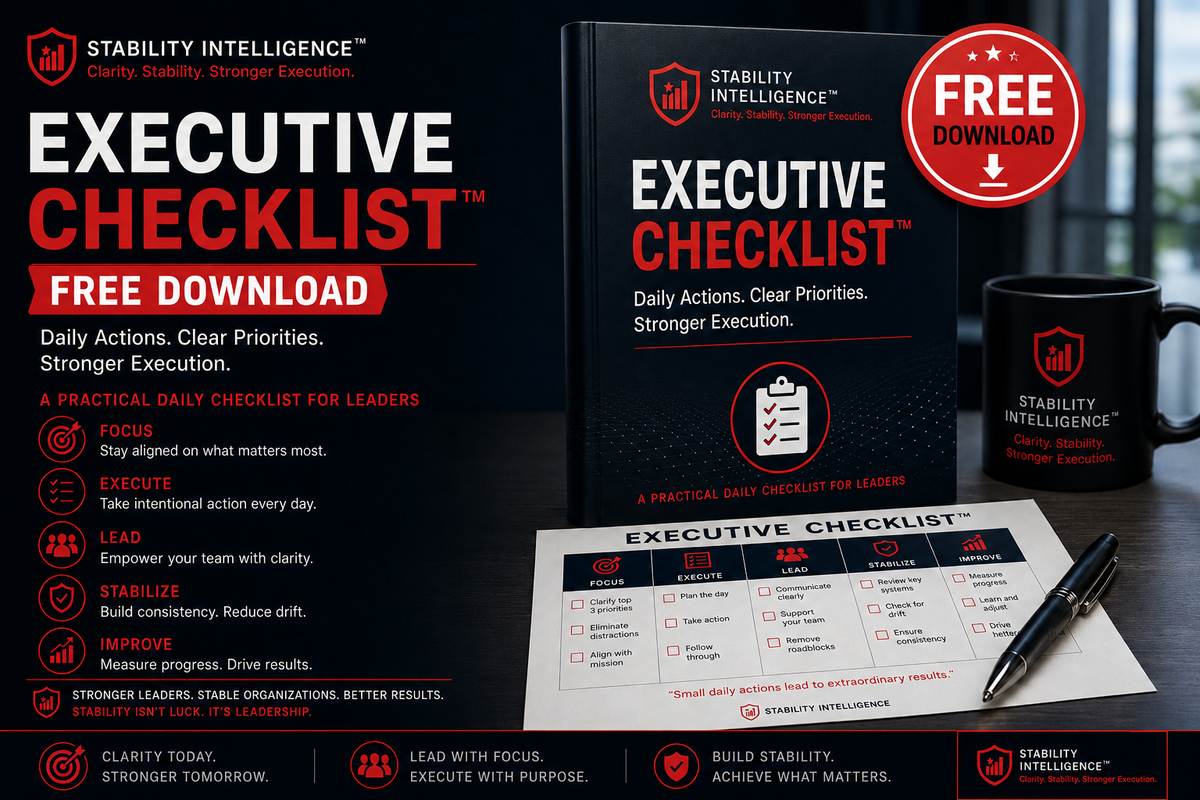
Tool: Executive Checklist™
Question: Should I be concerned?
Look for the initial signal.
- A process is skipped repeatedly.
- A leader must approve ordinary work.
- A team maintains a shadow system.
- A deadline depends on one person’s memory.
- Employees ask, “Who can get this pushed through?”
Color: Orange.
The Detect™ phase is melodic. The signal is present, but the pattern is not yet fully visible.
Reveal™
Tool: Field Guide™
Question: What am I actually looking at?
Move from First Signal to Forensic Evidence.
Map the workaround against the Drift Progression™ Ladder:
Friction → Drift → Instability → Structural Failure
Friction is the first resistance.
Drift begins when people adapt around it.
Instability appears when outcomes become inconsistent.
Structural Failure arrives when the system cannot function without constant intervention.
This is where you identify rework, approval loops, communication gaps, hidden labor, and ROI Leakage™.
Color: Blue.
The Reveal™ phase is dark. Not negative. Precise.
You are no longer asking whether the process is inconvenient.
You are identifying what the process is costing.
Repair™
Tool: Investigation Journal™
Question: What evidence do we have?
Record the case.
Document the official path.
Document the operating path.
Capture notes, observations, actions, exceptions, and historical patterns.
Color: Purple.
The Repair™ phase is aggressive. Not reckless. Decisive.
Repair the architecture that created the workaround.
Do not punish the person who exposed the weakness.
A Fixer follows the evidence to the break.
Diagnostic Daggers™
Use Diagnostic Daggers™ to expose truth without blame.
Ask directly:
- If the official process worked, would this workaround exist?
- What does the workaround accomplish faster or more clearly?
- Which control does the workaround bypass?
- Which person absorbs the hidden labor?
- What would fail first if that person left?
- What decision is being delayed by the formal path?
- What evidence would prove the workaround is now the standard?
Do not soften the questions.
Do not weaponize them either.
The goal is not confession.
The goal is visibility.
The Verdict: Stability Intelligence™
Ecosystem Step 3: The Verdict.
Stability Intelligence™ asks a harder question than, “Why are people not following the process?”
It asks:
Is the organization guilty of tolerating instability?
If the written process is consistently bypassed, the organization is not dealing with a compliance problem first.
It is dealing with an architecture problem.
The documented system and the operating system are two different systems.
One is designed.
One is trusted.
Execution reveals which one has structural integrity.
This is the difference between an Operator and an Orchestrator.
The Operator manages symptoms.
The Orchestrator redesigns the conditions producing them.
Most leaders do not have a confidence problem.
They have a stability problem.
When workarounds multiply, communication becomes private, decisions slow, accountability blurs, and leaders become indispensable for the wrong reasons.
That is not strength.
That is dependence.
Strength is alignment, structure, accountability, and leadership remaining steady under pressure.
The transformation isn’t a feeling; it’s a system.

The Sentence: The SQ Audit™
Ecosystem Step 4: The Sentence.
The Stability Quotient™ is the measurement.
The SQ Audit™ is the forensic diagnostic.
Run it when the workaround is no longer an exception.
Use it to evaluate the six domains where instability becomes visible:
- Leadership stability
- Communication stability
- Execution stability
- Accountability stability
- Process stability
- Organizational alignment
Look for the performance leaking through the workaround culture:
- Communication: Information moves through private channels.
- Decision-making: Formal approvals create Decision Latency™.
- Accountability: Ownership stays unclear.
- Operational alignment: Teams execute different versions of the same process.
The SQ Audit™ identifies Stability Signals™, evaluates hidden risks, and generates evidence-based recommendations. It produces a Stability Score™ that gives leaders a clearer starting point than instinct, urgency, or executive confidence.
Measure what the workaround is hiding.
Then stop calling the leak normal.
The Remedy: The Stability Installer™
Ecosystem Step 5: The Remedy.
The remedy is not another reminder to follow the process.
The remedy is system installation.
The Stability Installer™ rebuilds the operating system through the Architecture of Execution™.
This is the method.
Stability Infrastructure™ is the outcome.
The path is not a tool, a plaque, or a motivational message. The path is the Architecture of Execution™:
Stability Intelligence™ → Stability Quotient™ → D.R.I.L.L.™ → Architecture of Execution™ → Stability Infrastructure™
Install the corrected process.
Assign decision rights.
Remove unnecessary approval loops.
Make communication visible.
Create accountability mechanisms.
Test the process under pressure.
Then measure whether the workaround is still required.
That is how you move from Operator to Orchestrator™.
That is how you replace Human Glue Dependency™ with operational clarity.
That is how you build Organizational Stability™.
External Evidence
Source → No external source cited. Finding → This case file makes no external statistical or prevalence claim about workplace workarounds. SI relevance → The analysis is limited to the Stability Intelligence™ framework and the observable gap between documented and operating processes. Limitation → No general cost estimate or empirical percentage is asserted.
Access the Evidence
Run the SQ Audit™ to identify hidden risks, analyze Stability Signals™, measure performance leaking, and determine where execution has drifted out of alignment.
The SQ Drift Checklist™ is a two-part screening resource. Page 1, “The Drift,” is open. Page 2, “The Methodology,” is restricted to Vault and Private Ledger Access Tiers.
Access the SQ Drift Checklist™
Explore The SQ Course: The Private Ledger Edition for a structured path into the measurement framework.
For leaders ready to install stronger execution habits, the Executive Performance Collection™ reinforces the core mantra:
Execution Reveals Structure™
View the Executive Performance Collection™
Stability Intelligence™ Certification Course
Master the framework. Move from Operator to Orchestrator™ by installing the Architecture of Execution™ in your own organization.
Stability Intelligence™ Certification Course
Stability Signal Request
What instability are you seeing?
- Leadership Drift™
- Accountability Breakdown
- Communication Failure
- Decision Latency™
- Process Friction
- Human Glue Dependency™
- Other
Powered by Harmony Empower Group LLC
#GuiltyByAssociation #BoldLeadershipPath