
Forensic Case File Series: Guilty By Association™
Offense: Decision Latency™.
Case File Focus: The decision that keeps waiting for one more report, one more input, one more committee review.
You are assigned to this case because the delay is visible.
The decision is not.
A question enters the organization.
A meeting is scheduled.
A report is requested.
Another stakeholder is added.
The decision moves one week further away from execution.
Leadership calls this caution.
The organization experiences it as stalled work, idle capacity, confused priorities, and expired market windows.
Waiting is not neutral.
It is an operating cost.
The Charge: Guilty By Association™
This is The Charge in the Stability Intelligence™ Ecosystem.
The offense is not simply making a bad decision.
The offense is tolerating a system where decisions remain open long after the organization has enough information to act.
If a team cannot identify who owns the decision, what evidence is sufficient, or when the decision expires, then the organization has created a waiting room disguised as governance.
That waiting room has consequences:
- Execution pauses while teams wait for direction.
- Capacity sits idle or gets redirected to lower-value work.
- Managers repeat the same analysis for different audiences.
- Teams build competing assumptions.
- Customers receive slower responses.
- Market windows close before the organization reaches agreement.
- Accountability becomes difficult because no one officially decided.
This is how ROI Leakage™ begins.
Not through one dramatic failure.
Through small delays that compound downstream.
A one-day delay on a low-impact decision may be manageable.
A repeated delay across pricing, hiring, operations, customer response, product launches, and resource allocation becomes structural.
The question is direct:
Is the organization guilty of tolerating instability?
The Investigation: The Bold Ledger™
The Investigation is where The Bold Ledger™ operates.
The Bold Ledger™ is not a leadership newsletter.
It is a series of Forensic Case Files in Organizational Stability™.
It documents the evidence.
It names the operating pattern.
It gives leaders a way to examine instability without turning the investigation into a blame exercise.
The core evidence in this case is simple:
A decision has a clock.
The clock begins when the question is recognized.
It ends when a defensible choice is made and translated into action.
If the clock continues running because leaders keep requesting more information, the organization is not gathering clarity.
It is purchasing delay.
The cost of waiting
Quantify it.
Start with the stalled execution.
How many workstreams cannot proceed until this decision is made?
Then calculate idle capacity.
How many hours are being spent waiting, rechecking, escalating, or preparing alternate plans?
Then measure the expired window.
What customer need, hiring opportunity, revenue opportunity, or competitive response becomes less valuable with every day of delay?
A basic cost-of-delay model is direct:
Daily value at risk × days delayed = unpriced operating cost
The number does not need to be perfect to expose the pattern.
It needs to be visible.
External evidence supports the direction of this case. In West Monroe’s January 2026 Speed Wins research release, the company reported that 73% of surveyed leaders estimated their organizations lose up to 5% of annual revenue because of slow decision-making and delayed execution. The survey covered 214 C-suite executives and 1,000 managers at U.S. companies with at least $250 million in annual revenue and was conducted in November 2025. The finding is a survey-based estimate, not an independently audited measure of revenue loss. Its relevance here is narrower: it shows that leaders themselves recognize delay as a measurable performance drain, not merely an inconvenience. Source → Finding → SI relevance → Limitation: West Monroe, “Slow Decisions Are Costing Companies Millions in Lost Revenue,” PRNewswire, January 27, 2026, “Top findings” and “About the Research” sections → respondents estimated up to 5% revenue loss → supports treating decision speed as an operating variable → survey estimates should not be generalized to every organization.
The evidence points to a leadership design problem.
Technical skill is not enough.
Emotional intelligence is not enough.
Strategy is not enough.
If the organization cannot move from information to accountable action, the system is leaking.
The Investigation Process: D.R.I.L.L.™
Use D.R.I.L.L.™ to move from suspicion to evidence.
The five D.R.I.L.L.™ diagnostic categories are:
- Decision Latency™
- ROI Leakage™
- Implementation Failure™
- Leadership Drift™
- Leadership Alignment Gaps™
D.R.I.L.L.™ also moves through three process phases:
Phase 1: Detect™
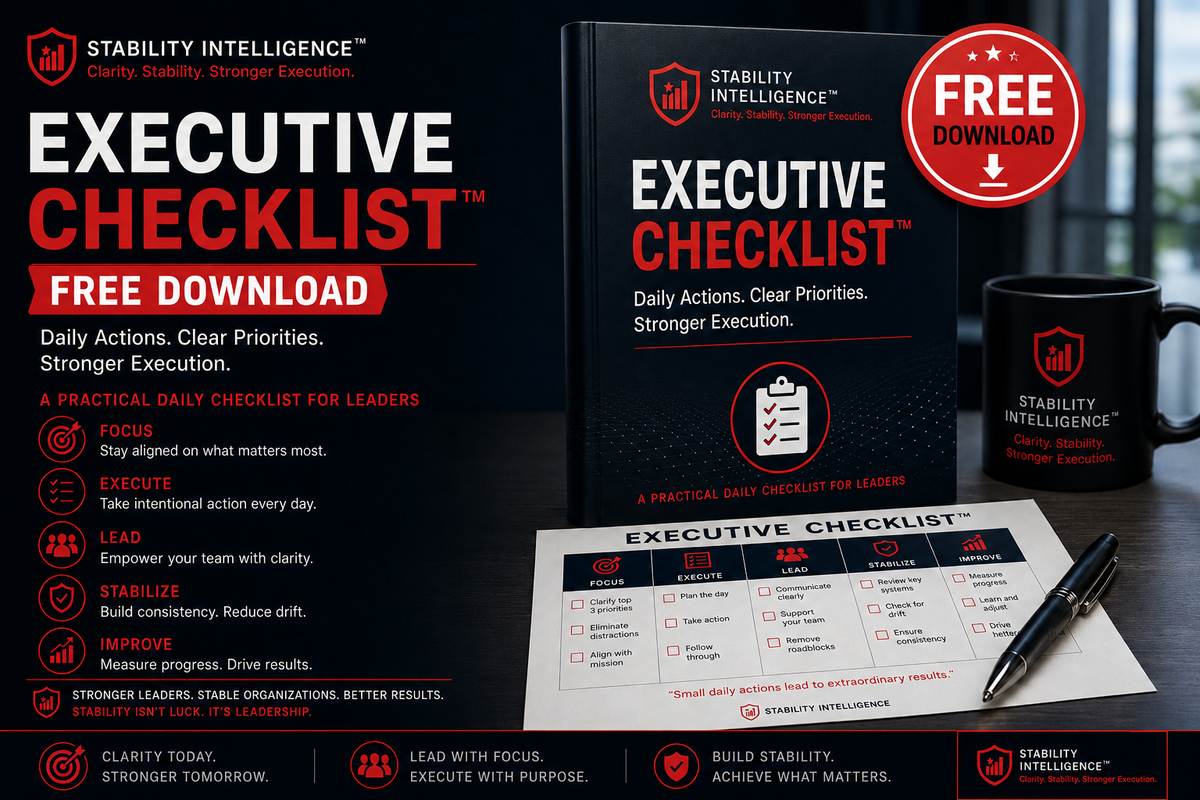
Tool: Executive Checklist™
Question: Should I be concerned?
Look for the first signal.
A decision has missed its stated date.
A team is asking for the same information again.
An approval path has expanded without improving the choice.
A leader says, “We are still gathering data,” but cannot define what data would be sufficient.
This phase is melodic.
The signal is present, but the organization can still respond before the delay becomes normalized.
Use the Executive Checklist™ to classify the initial signal as Green, Yellow, or Red.
Do not debate the signal into disappearance.
Record it.
Phase 2: Reveal™
Tool: Field Guide™
Question: What am I actually looking at?
This is where the tone changes from First Signal to Forensic Evidence.
Do not ask only, “Why is this decision late?”
Ask:
- Who owns the decision?
- What evidence has already been reviewed?
- What information is genuinely missing?
- What information is being requested because no one wants to carry risk?
- Which downstream teams are waiting?
- What work has already been duplicated?
- What market or operating window is closing?
- Where does authority stop?
- What would happen if the decision were made today?
Use the Drift Progression™ Ladder:
Friction → Drift → Instability → Structural Failure
Decision Latency™ often begins as friction.
Then it becomes drift.
Teams begin adjusting around the delay.
Then instability appears.
Roles blur. Priorities split. Workarounds become permanent.
The music gets dark because the pattern is no longer theoretical.
Phase 3: Repair™
Tool: Investigation Journal™
Question: What evidence do we have?
Document the decision history.
Record the question.
Record the owner.
Record the evidence available at each point.
Record the requests for additional data.
Record the downstream cost.
Record the final decision.
Record what changed after action.
Repair™ is aggressive because it ends the cycle of vague accountability.
It does not mean rushing every decision.
It means defining the threshold for action.
If the evidence is sufficient, decide.
If the evidence is insufficient, name what is missing, who owns the search, and when the decision returns.
No open-ended waiting.
No invisible queue.
No committee as a substitute for ownership.
Use Diagnostic Daggers™ to expose truth without blame:
- What decision is everyone discussing but no one owns?
- What is the cost of another seven days?
- Which team is carrying the delay?
- What information would actually change the decision?
- Who benefits from keeping the decision open?
- What is the smallest defensible action we can take now?
Visibility is the precursor to stability.
The smoke detector does not put out the fire.
It makes the invisible visible early enough to act.
The Verdict: Stability Intelligence™
This is The Verdict.
Stability Intelligence™ identifies Decision Latency™ as more than a time-management issue.
It is a stability condition.
The organization is stable when decisions, accountability, communication, and execution remain aligned under pressure.
The organization is unstable when teams depend on memory, personal escalation, or one heroic leader to keep work moving.
That is Human Glue Dependency™.
People are constantly holding the system together because the system does not hold.
A delayed decision creates performance leaking across four categories:
- Communication: teams receive partial or changing direction.
- Decision-making: authority becomes unclear.
- Accountability: ownership is distributed until no one is responsible.
- Operational alignment: teams optimize for different assumptions.
The transformation isn’t a feeling; it’s a system.
The verdict is not that leaders must become reckless.
The verdict is that leaders must install decision rules.
Define:
- Decision owners.
- Evidence thresholds.
- Expiration dates.
- Escalation paths.
- Reversible versus irreversible choices.
- Review windows.
- Measures of downstream impact.
Then measure the result through the Stability Score™.
The Sentence: The SQ Audit™
The Sentence is measurement.
The Stability Quotient™ is not a confidence rating.
The SQ Audit™ is a forensic diagnostic designed to evaluate Organizational Stability™, identify hidden risks, analyze Stability Signals™, and generate evidence-based recommendations.
For this case, examine:
- How long decisions remain open.
- How many approvals are required.
- How often decisions are revisited.
- How much work waits downstream.
- How often teams act on assumptions.
- Where rework begins.
- Whether leaders are making decisions or merely hosting discussions.
Run the SQ Audit™ when delay has become a pattern.
Do not wait for a visible failure.
The Stability Quotient™ reveals where execution, communication, leadership, and decision-making have drifted out of alignment.
That is how leaders move From Operator to Orchestrator™.
Stop managing symptoms.
Start orchestrating outcomes.
The Remedy: The Stability Installer™
The remedy is not another meeting.
It is not a motivational speech.
It is not a plaque.
The remedy is system installation through the Architecture of Execution™.
The sequence is unidirectional:
Stability Intelligence™ → Stability Quotient™ → D.R.I.L.L.™ → Architecture of Execution™ → Stability Infrastructure™
D.R.I.L.L.™ investigates.
The Architecture of Execution™ installs.
INSTALL™ is the transition after the diagnostic work. It is not a fourth D.R.I.L.L.™ phase.
Build a decision operating system that makes action easier than avoidance.
Set decision rights.
Create evidence thresholds.
Make cost-of-delay visible.
Give teams permission to act within defined boundaries.
Review outcomes without punishing every defensible mistake.
If leaders want stability under pressure, they must build structure that survives pressure.
Execution Reveals Structure™
That is the operating principle behind the Executive Performance Collection™.
It is not about displaying confidence.
It is about reinforcing the difference between heroics and infrastructure.
Heroics do not scale. Systems do.
Access the Evidence
The Vault is visible.
Access is restricted.
The Bold Ledger™ serves as the Operating System Key for evidence and methodology.
Begin with the SQ Drift Checklist™. Page 1, The Drift, is an open screening resource. Page 2, The Methodology, is reserved for restricted Vault and Private Ledger Access Tiers.
Then choose the next level of investigation:
- Run the SQ Audit™ to quantify organizational drift and identify performance leaking.
- Explore The SQ Course: The Private Ledger Edition for a focused Stability Quotient™ experience.
- Review the Executive Performance Collection™ through the From Operator to Orchestrator™ lens.
Stability Intelligence™ Certification Course
Master the framework. Move from Operator to Orchestrator™ by installing the Architecture of Execution™ in your own organization.
Stability Intelligence™ Certification Course
Stability Signal Request
What instability are you seeing?
- Leadership Drift™
- Accountability Breakdown
- Communication Failure
- Decision Latency™
- Process Friction
- Human Glue Dependency™
- Other
Powered by Harmony Empower Group LLC
#GuiltyByAssociation #BoldLeadershipPath